Monday, February 21, 2011
Cullen Meaning from the American Dream (pun intended)
I really enjoyed the reading for class today. As I read the assigned chapter 3 of Jim Cullen's The American Dream the pages flew by. They were interesting, approachable, and concise. While maybe not the most dense reading I've done for the class, it was a nice break from more dense pieces like the excerpts of "Democratic Vistas" and the last speech/article on American pietism. While not overly complex, I still thought Cullen did a good job of demonstrating the American Dream as being largely about upward mobility, and unlike McLoughlin, showing how it has evolved over the short life of this nation.

Thursday, February 17, 2011
Misconceptions On 20th Century American Liturature
In the article, Pietism and the American Character, William McLouglin begins to wrap up his sweeping piece that generalizes American culture and society as a whole (as of 1965, when the article was published) by commenting on how even modern American literature conforms to his thesis on American pietism.
Some of the examples like Faulkner and Melville's works seem to fit with the religiosity McLouglin speaks of. Others like Salinger, Fitzgerald, and Hemingway (who is conveniently left out) fall flat to me. In order to make the former two examples work, William has to go so far and become so vague that he simply says that their "quest for perfection is bound to fail because it is based on false premises, nevertheless write on in search of it." Frankly, this sentence to me says very little about the authors at all. Does any author really think their book is perfect? Hemingway was the king of revision and even said in an interview, "I rewrote the ending of Farewell to Arms 39 times before I was satisfied." Does this show he's dedicated to his craft? Of course it does; writing was his job and he clearly took it seriously. Does this mean he was in a "quest for perfection" guided by the ideals of American pietism? Not at all. He is quoted as saying "until I was satisfied," which is worlds away from "before it was perfect."
Then WIlliam quotes Lewis who comments on the heroes of contemporary American fiction, stating that they "share in their common aloneness...each of them struggles tirelessly, sometimes unwittingly and often absurdly, to realize the full potentialities of the classic figures which each represents: the Emersonian figure, 'the simple genuine self against the whole world."
I personally don't explicitly disagree with this statement by Lewis, but I definitely disagree with where William takes he. The author of the article continues on to relate these "classic Emersonian figures" to the "classic pietistic figure of the Christian man."
Let's quickly review the characters that could fall into the category McLoughlin is trying to call the "classic pietistic figure[s] of the Christian man:"
Nick Carraway
Frederic Henry
Holden Caulfield
and so forth...
Also, this talk of absurd, tiresome struggle sounds quite a bit like Camus' brand of Absurdism, as exemplified in both The Plague and The Stranger. By making the qualifications to support his argument so incredibly broad, William McLoughlin has really just described a lot of literature, both American and foreign.
I realize that I wasn't around in the year 1965 so I may have some delusions about what the state of America was like at that time, but there are some things I do know for a fact.
In the year 1965:
Hemingway's A Farewell to Arms, Camus' The Stranger and The Plague, Salinger's Catcher in the Rye, and Fitzgerald's The Great Gatsby had all been published.
Camus, Fitzgerald, and Hemingway had all died prior to this article's publication.
The Grateful Dead was in it's first year of existence.
Andy Warhol was extremely active in the art world. (Conveniently left unmentioned in the section on art)
Andy Warhol is undoubtably a quintessential, iconic American artist, who completely goes against the idea of American pietism.
What I'm trying to get at here, is that while for part of the population this American pietism is viewed as the essence of being an American, there was at the time this article was written, already a strong counter culture that would strongly disagree with this. This includes some authors William tried to use it make his argument, as well as ones he just ignores completely.
...and don't even get me started on McLoughlin's use of the term "conspicuous consumption," which was borrowed from American economist Thorstein Veblen...
Also, here's a modern adaptation of the "American Dream:"
http://greatgatsbygame.com/
Some of the examples like Faulkner and Melville's works seem to fit with the religiosity McLouglin speaks of. Others like Salinger, Fitzgerald, and Hemingway (who is conveniently left out) fall flat to me. In order to make the former two examples work, William has to go so far and become so vague that he simply says that their "quest for perfection is bound to fail because it is based on false premises, nevertheless write on in search of it." Frankly, this sentence to me says very little about the authors at all. Does any author really think their book is perfect? Hemingway was the king of revision and even said in an interview, "I rewrote the ending of Farewell to Arms 39 times before I was satisfied." Does this show he's dedicated to his craft? Of course it does; writing was his job and he clearly took it seriously. Does this mean he was in a "quest for perfection" guided by the ideals of American pietism? Not at all. He is quoted as saying "until I was satisfied," which is worlds away from "before it was perfect."
Then WIlliam quotes Lewis who comments on the heroes of contemporary American fiction, stating that they "share in their common aloneness...each of them struggles tirelessly, sometimes unwittingly and often absurdly, to realize the full potentialities of the classic figures which each represents: the Emersonian figure, 'the simple genuine self against the whole world."
I personally don't explicitly disagree with this statement by Lewis, but I definitely disagree with where William takes he. The author of the article continues on to relate these "classic Emersonian figures" to the "classic pietistic figure of the Christian man."
Let's quickly review the characters that could fall into the category McLoughlin is trying to call the "classic pietistic figure[s] of the Christian man:"
Nick Carraway
Frederic Henry
Holden Caulfield
and so forth...
Also, this talk of absurd, tiresome struggle sounds quite a bit like Camus' brand of Absurdism, as exemplified in both The Plague and The Stranger. By making the qualifications to support his argument so incredibly broad, William McLoughlin has really just described a lot of literature, both American and foreign.
I realize that I wasn't around in the year 1965 so I may have some delusions about what the state of America was like at that time, but there are some things I do know for a fact.
In the year 1965:
Hemingway's A Farewell to Arms, Camus' The Stranger and The Plague, Salinger's Catcher in the Rye, and Fitzgerald's The Great Gatsby had all been published.
Camus, Fitzgerald, and Hemingway had all died prior to this article's publication.
The Grateful Dead was in it's first year of existence.
Andy Warhol was extremely active in the art world. (Conveniently left unmentioned in the section on art)
Andy Warhol is undoubtably a quintessential, iconic American artist, who completely goes against the idea of American pietism.
What I'm trying to get at here, is that while for part of the population this American pietism is viewed as the essence of being an American, there was at the time this article was written, already a strong counter culture that would strongly disagree with this. This includes some authors William tried to use it make his argument, as well as ones he just ignores completely.
...and don't even get me started on McLoughlin's use of the term "conspicuous consumption," which was borrowed from American economist Thorstein Veblen...
Also, here's a modern adaptation of the "American Dream:"
http://greatgatsbygame.com/
Friday, February 11, 2011
Paul Johnson, may I have a word?
Paul Johnson and I have a history. Well actually we have two histories. And they don't always match. Early on in the school year, I was assigned to read A History of the American People for AmCon, and it has been a trying experience ever since. I have sarcastically referred to him as "fellow scholar Paul Johnson" and even several times completely skipped reading the assigned sections of his books. Was it noticeable? Hardly. When it comes to hypothesizing what the esteemed Mr. Johnson has to say on a subject, the process is usually as follows:
Q. Does it have to do with a founding father or major Christian religious figure?
A. You'll usually find a glowing review of the character of the individual, with little about the events that actually took place. (See Ben Franklin, Thomas Jefferson, John Winthrop)
Q. Does it have to do with anything in contrast with the modern conservative ideology?
A. Look in Zinn. You'll probably find very little or else Johnson has conveniently erased it from history.
Q. Will what I'm looking for be discussed (if it is discussed; see second question) in an objective, fair, and rational manner?
A. Probably not. Johnson's religious schooling (Note: not necessarily a bad thing; one of the few things Pauly and I have in common.) seems to have blinded him and left him unable to remain even somewhat objective in his sweeping prose.
Of course there are exceptions to these broad generalizations, which is why I continue to read on in Mr. Johnson's history. Hopefully, it will allow me to better refine mine.
On a more positive note, I did enjoy his linking of the Second Great Awakening and the birth of the modern cereal industry.
Q. Does it have to do with a founding father or major Christian religious figure?
A. You'll usually find a glowing review of the character of the individual, with little about the events that actually took place. (See Ben Franklin, Thomas Jefferson, John Winthrop)
Q. Does it have to do with anything in contrast with the modern conservative ideology?
A. Look in Zinn. You'll probably find very little or else Johnson has conveniently erased it from history.
Q. Will what I'm looking for be discussed (if it is discussed; see second question) in an objective, fair, and rational manner?
A. Probably not. Johnson's religious schooling (Note: not necessarily a bad thing; one of the few things Pauly and I have in common.) seems to have blinded him and left him unable to remain even somewhat objective in his sweeping prose.
Of course there are exceptions to these broad generalizations, which is why I continue to read on in Mr. Johnson's history. Hopefully, it will allow me to better refine mine.
On a more positive note, I did enjoy his linking of the Second Great Awakening and the birth of the modern cereal industry.
Tuesday, February 8, 2011
Does Walter Falter?
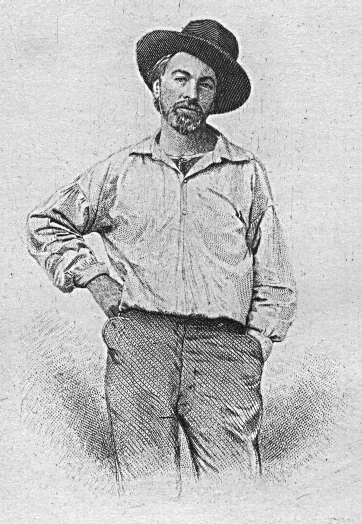
It is important when reading Whitman’s “Democratic Vistas” to understand the context in which it was written. As can be expected, America was a very different place in the year 1871, and Whitman’s observations certainly reflect this. David Brooks wrote an modern reflection on Whitman’s essay, which helps convey the happenings of Whitman’s era. Brooks tells his readers that Whitman was optimistic that the Civil War would have purged the rejoined states of their prior problems and allow them to move forward in terms of culture, education, and literature. Whitman speaks of an ideal future America where the nation is a stronger democracy through “the copious production of perfect characters among the people, and though the advent of a sane and pervading religiousness.” Although there is certainly contention over what exactly the “American dream” is, it is safe to say that this is not everyone’s idea of it.
This is not to say, necessarily, that the American Dream has changed or expanded. Whitman, while one of the most critically acclaimed American poets of all time, cannot and did not speak for every one of this contemporaries. The number of people that do agree with his notion of the American dream, I would say, has likely fallen greatly since the year 1871 though. I am also willing to argue that his lofty aspirations for the United States of America have not even come close to having been fulfilled in the one hundred-forty years that have elapsed since “Democratic Vistas” was written. Whitman repeatedly explains that expects a class of elite writers, unlike what the world has ever seen, to arise from America. He also calls the “American born populace, the peacablest and most good-natured race in the world” as well as the “most personally independent and intelligent.”
While I would love to say that Walt was spot on with his predictions, I’m afraid that there are glaring statistics that would serve as an irrefutable rebuttal. The body of literature that has come out of America in the last century hardly compares the canon of classics that exists. I love Bukowski as much as, if not more than, the next guy, and Salinger could certainly put words together, but America hasn’t produced anything close to the level of Tolstoy, Dostoyevsky, or Shakespeare. I think the American industrial military complex says plenty and violent crime statistics say more than enough about the “peaceablest and most good-natured race in the world” part of Whitman’s prediction. As for intelligence, American children are falling behind other nations in terms of education; there is nothing intelligent about failing to invest in future generations. The aspect of today’s American population Whitman comes closest to being right about would be the independence part. Unfortunately, if you ask Robert Putnam he’d tell you that’s not necessarily a good thing. In fact he’d go so far as tell you that this lack of social capital is leading to the disintegration of the American community.
However, if Whitman were to read this response today, David Brooks says that he would likely agree with a large part of it. In fact shortly after writing “Democratic Vistas” Whitman realized that perhaps his optimism got the best of him and the American people are largely more apathetic then he initially realized. I was somewhat surprised that Brooks wrote such a glowing response to this essay. What Brooks seems to have liked about “Vistas” was the way it aligns so well with the ideas of American exceptionalism and overall patriotism. Brooks even opens his piece with “Whenever I hear people say something stupid about America, which is often these days, I want to punch them in the nose and hand them Walt Whitman’s 1871 essay ‘Democratic Vistas’.” Maybe this poor first impression has tainted the voice Brooks writes with for me, but saying this and then talking about how even Whitman came to realize how he was disillusioned about America makes Brooks seems almost as contradictory as Whitman was. The difference is that Whitman openly admitted his contradictions. But maybe I just need a punch in the nose.
Subscribe to:
Posts (Atom)