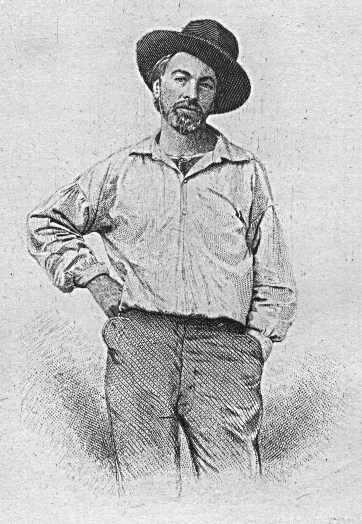
It is important when reading Whitman’s “Democratic Vistas” to understand the context in which it was written. As can be expected, America was a very different place in the year 1871, and Whitman’s observations certainly reflect this. David Brooks wrote an modern reflection on Whitman’s essay, which helps convey the happenings of Whitman’s era. Brooks tells his readers that Whitman was optimistic that the Civil War would have purged the rejoined states of their prior problems and allow them to move forward in terms of culture, education, and literature. Whitman speaks of an ideal future America where the nation is a stronger democracy through “the copious production of perfect characters among the people, and though the advent of a sane and pervading religiousness.” Although there is certainly contention over what exactly the “American dream” is, it is safe to say that this is not everyone’s idea of it.
This is not to say, necessarily, that the American Dream has changed or expanded. Whitman, while one of the most critically acclaimed American poets of all time, cannot and did not speak for every one of this contemporaries. The number of people that do agree with his notion of the American dream, I would say, has likely fallen greatly since the year 1871 though. I am also willing to argue that his lofty aspirations for the United States of America have not even come close to having been fulfilled in the one hundred-forty years that have elapsed since “Democratic Vistas” was written. Whitman repeatedly explains that expects a class of elite writers, unlike what the world has ever seen, to arise from America. He also calls the “American born populace, the peacablest and most good-natured race in the world” as well as the “most personally independent and intelligent.”
While I would love to say that Walt was spot on with his predictions, I’m afraid that there are glaring statistics that would serve as an irrefutable rebuttal. The body of literature that has come out of America in the last century hardly compares the canon of classics that exists. I love Bukowski as much as, if not more than, the next guy, and Salinger could certainly put words together, but America hasn’t produced anything close to the level of Tolstoy, Dostoyevsky, or Shakespeare. I think the American industrial military complex says plenty and violent crime statistics say more than enough about the “peaceablest and most good-natured race in the world” part of Whitman’s prediction. As for intelligence, American children are falling behind other nations in terms of education; there is nothing intelligent about failing to invest in future generations. The aspect of today’s American population Whitman comes closest to being right about would be the independence part. Unfortunately, if you ask Robert Putnam he’d tell you that’s not necessarily a good thing. In fact he’d go so far as tell you that this lack of social capital is leading to the disintegration of the American community.
However, if Whitman were to read this response today, David Brooks says that he would likely agree with a large part of it. In fact shortly after writing “Democratic Vistas” Whitman realized that perhaps his optimism got the best of him and the American people are largely more apathetic then he initially realized. I was somewhat surprised that Brooks wrote such a glowing response to this essay. What Brooks seems to have liked about “Vistas” was the way it aligns so well with the ideas of American exceptionalism and overall patriotism. Brooks even opens his piece with “Whenever I hear people say something stupid about America, which is often these days, I want to punch them in the nose and hand them Walt Whitman’s 1871 essay ‘Democratic Vistas’.” Maybe this poor first impression has tainted the voice Brooks writes with for me, but saying this and then talking about how even Whitman came to realize how he was disillusioned about America makes Brooks seems almost as contradictory as Whitman was. The difference is that Whitman openly admitted his contradictions. But maybe I just need a punch in the nose.

No comments:
Post a Comment